Barcode-based workflows from collection to analyser
Learn how barcode-based workflows connect patient orders, specimens, analyser worklists and results while maintaining identity checks, exception handling and complete traceability.
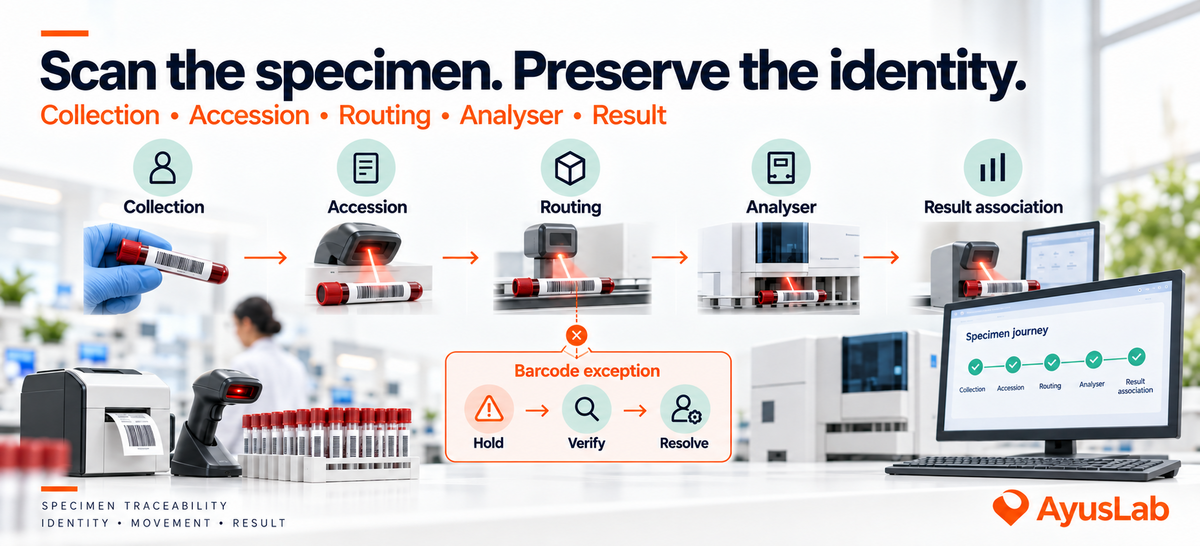
A barcode can connect an order, specimen, analyser worklist and result without repeated manual entry. But it does not establish identity on its own. It is a machine-readable key whose reliability depends on patient identification, the record it resolves to, the container and each scan control.
A well-designed workflow therefore does more than print labels. It defines what each barcode identifies, when it is generated, who confirms collection, how the specimen is received and routed, how the analyser obtains the correct worklist, how results return to the correct record and what happens when scanning fails.
ISO 15189:2022 is the current international standard for medical laboratory quality and competence. ISO 20658:2023 addresses collection and transport, including examination requests, patient preparation and identification, sample collection and transport. In India, NABL 112A adds specific expectations for information systems, analyser interfaces, audit trails and workflow verification. Laboratories should confirm detailed requirements against licensed standards, current NABL documents and local rules.
1. What the barcode identifies
The first design decision is whether the barcode identifies an order, an accession, an individual container, an aliquot or another laboratory object. These are not always the same thing.
One patient visit may contain several orders and several containers. A serum tube, EDTA tube and urine container may share an accession while requiring different processing and destinations. If the same barcode is printed on every container without a defined container relationship, the system may know the patient encounter but not which material was scanned.
A stronger model uses a stable accession or order relationship and a unique container identifier where required. Derived aliquots receive identifiers linked to the parent specimen. Human-readable information supports visual checking when a scanner is unavailable. The barcode need not carry more patient information than necessary; it can resolve a protected identifier inside the authorised system.
2. Generate labels at the controlled point
Label generation should follow a valid request and the selection of the required specimen and container. The system needs to know the tests ordered, specimen type, container requirements, collection site and any handling or priority instructions before producing the label set.
Printing labels too early or in large unattended batches creates opportunities for swapping. Printing only after collection can leave an unlabelled specimen beside the patient. The laboratory should define the safe sequence for its setting - for example, print the labels for one identified patient, verify them against the request, collect the specimen and apply the correct label immediately in the patient's presence.
Printer configuration is part of the control. Size, quiet zones, contrast, orientation, adhesive and resistance to moisture or cold affect readability. Labels must not obscure fill lines or interfere with analyser racks. Validate templates, printers and symbologies under actual collection, transport, storage and analyser conditions.
3. Confirm collection, not just printing
Scanning a label is not a substitute for identifying the patient. Staff must first follow the laboratory's approved identity-verification process and match the request, patient and required specimen. The barcode workflow should then record that the specific container was collected.
A collection confirmation can capture the container, collector, time, location, specimen type and status. It may record why collection was incomplete, deferred or unsuccessful. In mobile or bedside collection, scanning the patient or request and container can create a deliberate match check before departure.
The system should block or prominently flag duplicate collection of the same required container unless an approved recollection or additional-specimen workflow is selected. It should also distinguish printed, collected, cancelled and recollected labels so that an unused printout cannot silently become a valid specimen later.
4. Scan accession and routing events
At receipt, the scan should open the expected record and support acceptance checks - not automatically accept whatever label is presented. Staff may need to confirm container type, volume, integrity, transport conditions, collection time and consistency with the request. An unexpected, duplicate or cancelled identifier should stop normal routing.
Once accepted, scan events can record reception, centrifugation, separation, department assignment, referral, storage and disposal. The laboratory need not scan every movement; it should choose points where identity, custody, status or turnaround-time evidence materially changes.
Aliquots need parent-child traceability. A new aliquot barcode should link to the source container, preparation event, operator and intended tests. It should never look like an unrelated specimen. When a specimen is stored, the identifier can also be associated with a defined rack, box or location so that retrieval and disposal remain connected to the analytical history.
5. Build the analyser worklist safely
In an interfaced workflow, the analyser reads the container barcode and associates it with the tests expected for that specimen. The analyser may receive a downloaded worklist, query the LIS or middleware when the barcode is scanned, or use another validated interface pattern. The exact behaviour depends on the analyser and interface design.
The interface must map laboratory and analyser test codes, specimen requirements, units and result formats correctly. A successful message can still be wrong if an identifier is truncated, a code is mis-mapped or a reused barcode resolves to another order.
NABL 112A states that interfaces between analysers and the LIS, and between software systems, should be verified to ensure intended transmission and avoid misfiled results or incorrect report formatting. Verification should include representative normal cases and exceptions such as add-on tests, cancelled tests, reruns, aliquots, duplicate identifiers, unknown barcodes and interface downtime.
6. Associate results with the right record
When the analyser returns a result, the system should match more than the presence of a barcode string. It should reconcile the container or sample identifier, expected test, analyser source, message structure and current order status. Unexpected results should enter a controlled exception queue rather than automatically attaching to the nearest apparent match.
Returned flags, instrument comments, dilution or rerun information and timestamps should remain linked to the analytical event. Downtime entry needs equivalent identity checks, authorised access and a reason. On recovery, duplicate messages must be detected rather than creating parallel results.
The final report remains subject to the laboratory's review and authorisation rules. Barcode matching improves association and reduces transcription, but it does not decide whether the specimen or result is valid.
7. Control exceptions and relabelling
Common exceptions include unreadable labels, damaged tubes, duplicate barcodes, a mismatch between human-readable text and the electronic record, unexpected specimen type, an identifier unknown to the analyser, or a label found on the wrong container.
The safe response is not simply to print another label. The specimen should be held from routine processing while authorised staff establish what can be reliably confirmed. The procedure should specify when relabelling is permitted, what evidence is required, who may approve it and when recollection is necessary. If identity cannot be established with confidence, a new label cannot correct the underlying uncertainty.
When relabelling is authorised, preserve both identifiers, the reason, user, time and their relationship. Manual barcode entry or override should be visible in the audit trail. A replacement label must not erase the original event.
8. Audit the pathway and its performance
An audit should reconstruct the specimen journey: request, label generation, collection confirmation, receipt, acceptance, routing, analyser exchange, result receipt, review, storage and disposal. NABL 112A expects information systems to manage workflow, quality and audit trails and links audit activity to patient data and software changes.
Useful performance measures include scan compliance at defined control points, unreadable-label rate, duplicate-label events, relabelling and manual-entry frequency, specimens received without expected collection confirmation, analyser unknown-ID errors, interface mismatches, misroutes and time spent in exception queues. Rates need suitable denominators and trends; raw totals alone can reflect changing workload.
Patterns should lead to investigation. Repeated scanning failures may come from printer calibration, label material, placement, workflow design, training, analyser readers or interface mapping. The objective is not to maximise scan counts but to improve identity control and traceability at the points that matter.
Where a LIMS can support the workflow
Subject to product-owner verification of current behaviour, AyusLab may support barcode generation, collection and receipt confirmation, department routing, parent-child aliquot links, analyser worklists, result association, exception handling and audit history. Relevant screens, fields and interface behaviour must be verified before publication.
A LIMS can connect and record the workflow, but the laboratory must define its identifiers, label content, scan points, acceptance criteria, relabelling authority, downtime procedure and professional review. Software does not turn an uncertain specimen into a correctly identified one.
The barcode is only as strong as the workflow
A reliable barcode-based laboratory workflow maintains one connected identity from collection to analyser and beyond. At every control point, the team should be able to answer: What object was scanned? What record did it resolve to? Was that relationship expected? Who confirmed the event? What happens if it does not match?
Frequently asked questions
What is the simplest definition of a barcode-based workflow from collection to analyser?
It is a laboratory process in which machine-readable identifiers connect orders, containers, scan events, analyser worklists and results while preserving checks and exceptions at each stage.
Which part of the laboratory workflow is responsible?
Responsibility is shared. Registration and collection establish the order and specimen relationship; reception and technical sections confirm acceptance and routing; interface teams maintain analyser mappings; authorised laboratory staff review results and exceptions.
What records should remain available for review?
Retain label-generation history, identifier relationships, collection and receipt events, routing and aliquot records, analyser messages, results, overrides, relabelling decisions, downtime entries, authorisation and storage or disposal events according to the approved retention policy.
Where can a LIMS help, and where is professional judgement still required?
A LIMS can generate identifiers, route work, exchange analyser messages, detect configured mismatches and retain the audit trail. Laboratory staff must verify identity, assess specimen suitability, resolve exceptions, approve relabelling and authorise results.
Reviewing your own lab's processes?
A Lab Growth Session walks through your turnaround time, rejection rates and workflow with our team.
Book a Lab Growth Session