How to define and manage turnaround time by test and workflow stage
Understand how laboratories can define meaningful TAT, track each workflow stage, identify delays and use LIMS visibility to support timely and measurable improvement.
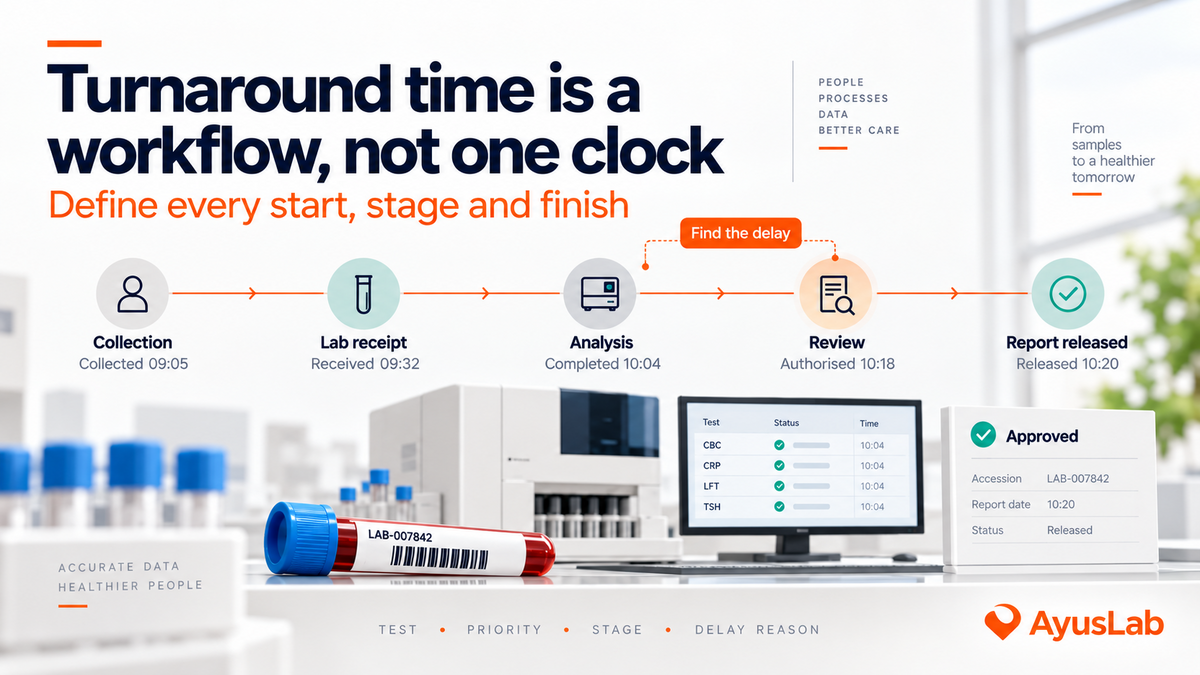
Turnaround time (TAT) is often discussed as though every laboratory result follows one clock. A glucose result produced on site, a culture requiring incubation and a referred test have different workflows and uses. Even for one test, TATcould mean collection to report, receipt to authorisation or analyser start to result.
ISO 15189:2022 defines turnaround time as the elapsed time between two specified points across pre-examination, examination and post-examination processes. The practical implication is important: a TAT value is incomplete unless its start event, end event, test scope and priority category are defined.
1. Why one TAT definition is insufficient
A laboratory-wide average combines unlike work. Fast routine chemistry can conceal delayed microbiology, referral testing or specialist review—and hide where time was spent.
A laboratory may need several related views:
- Total service TAT: specimen collection to authorised report availability.
- Laboratory TAT: specimen receipt or accession to authorised release.
- Analytical TAT: analytical start to a technically valid result.
- Post-analytical TAT: result availability to review, authorisation or release.
- Urgent communication interval: identification of a critical result to acknowledgement by an authorised recipient.
These intervals answer different questions. Laboratory TAT helps manage internal operations; total service TAT also exposes collection and transport delays. Critical-result communication remains a separate closed-loop measure because report release does not demonstrate successful urgent communication.
2. Start and end events
Each definition should name observable events. Received- may mean arrival at a collection centre, testing laboratory or electronic accession. Completed- may mean technical validation, pathologist authorisation, portal release or clinician acknowledgement.
The laboratory should document:
| Element | Example definition |
|---|---|
| Start event | Specimen accessioned at the testing laboratory |
| End event | Complete report authorised and available to the intended user |
| Population | Routine serum potassium performed on site |
| Clock | Continuous elapsed time, including nights and weekends |
| Target | Laboratory-approved target based on service need and capability |
| Exclusions | Precisely defined cancellations or documented events outside the measure |
Any clock-pause rule must be explicit and auditable. Broad exclusions can improve the number without improving service. It is usually better to retain delayed cases, code their reasons and analyse them separately.
3. Test and priority categories
Targets should follow meaningful workflow differences: discipline, test group, method, site, on-site versus referred testing, continuous versus batch processing and specialist interpretation.
Priority also needs controlled definitions. Routine and Urgent should not be informal labels chosen differently by each user. The laboratory should agree who may assign priority, what workflow it triggers and what target applies. Public ISO 15189 assessment guidance specifically expects instructions for urgent samples, including special identification, transport, rapid processing, turnaround time and reporting criteria.
No universal TAT target suits every laboratory. Targets should consider clinical need, service agreements, sample stability, method duration, operating hours, transport schedules, staffing, equipment capacity and referral-laboratory commitments. A profile or panel also needs a rule: is its TAT measured when the first component is available or only when the complete report is authorised?
4. Operational and clinical TAT
Operational TAT measures what the laboratory directly manages, such as accession to release. A broader service measure may start at collection and include transport. Both are useful but distinct.
The laboratory should avoid describing a shorter operational TAT as a guaranteed clinical outcome. Result availability is only one part of care. A clinician may still need to access, interpret and act on the result. For urgent or critical findings, the laboratory's approved communication process should define recipient, acknowledgement, escalation and documentation independently of the routine report channel.
A practical dashboard can therefore show a primary service measure beside the operational intervals that explain it. This connects user experience with the stage the laboratory can improve.
5. Stage timestamps
End-to-end TAT reveals that a delay occurred; stage timestamps reveal where. Depending on the workflow, useful events include:
- Order created and specimen collected
- Specimen dispatched and received
- Accession and preparation completed
- Analysis started and completed
- Result entered or interfaced
- Technical or clinical review completed
- Report authorised and released
- Critical communication acknowledged, when applicable
From these events, the laboratory can calculate transport, accession, preparation, analytical, review and reporting intervals. Systems should use synchronized clocks and consistent time zones. Manual timestamps should be identified as such, and downtime reconciliation should preserve both the actual event time and later entry time.
Not every test requires every timestamp. Capture events that correspond to a real hand-off, queue or controllable risk. Excessive timestamps that staff cannot record reliably create noise rather than insight.
6. Delay reason codes
An outlier without a reason is difficult to act on. A short, controlled set of delay codes can distinguish transport delay, specimen problem, QC or calibration hold, analyser downtime, reagent shortage, repeat or dilution, referral delay, specialist review, interface failure and inability to contact the recipient.
The code should describe the immediate operational cause, while significant or recurrent events may require separate root-cause investigation. Free text can add context but should not replace structured categories. Each recorded delay should retain the test, stage, timestamp, responsible area, selected reason and relevant action.
Reason codes should be reviewed for misuse. If almost every breach is marked other or excluded as unavoidable the classification is not supporting improvement.
7. Alerts and communication
Alerts are most useful before a target is missed. A LIMS may calculate the expected due time from the test, priority, site and current workflow stage, then place approaching or overdue work in an exception queue. Escalation can reflect the laboratory's approved responsibility matrix.
An alert should show the specimen, test, priority, current stage, elapsed time and responsible area. Repeated notifications without ownership create alarm fatigue. Procedures should define the reviewer, expected action and escalation point.
When a material delay may affect service, communication should be recorded, including the recipient, time, message and revised expectation where appropriate. Software can surface the delay, but laboratory professionals decide its significance and the required response.
8. Indicators and improvement
Average TAT alone is weak because a small number of severe delays can be hidden. A balanced review may include:
- Median TAT for typical performance
- 90th or 95th percentile TAT for the slower tail
- Percentage completed within the approved target
- Outlier rate, with a defined numerator and denominator
- Stage duration and delay reasons by test, site, shift or priority
The CAP's current STAT TAT monitor, for example, expresses outliers as the percentage of tests missing an institution's established reporting deadline and analyses them by shift and day. This illustrates two sound principles: the laboratory establishes its defined target, and performance is examined in operational context.
Start with a validated baseline. Confirm timestamp completeness, interface behaviour, duplicate handling and exclusions before interpreting trends. Select indicators linked to action. If delay lies before preparation, adding analyser capacity may not help; if results wait for review, queue design or staffing may matter more.
ISO 15189-aligned assessment guidance expects quality-indicator monitoring to define objectives, methodology, interpretation, limits, action plans and duration, followed by periodic review. The value of TAT measurement is therefore not a faster-looking dashboard. It is a repeatable process for locating delay, testing an improvement and checking whether performance changed without weakening result quality.
How a LIMS can support TAT visibility
After the product owner verifies current behaviour, AyusLab may be described in terms of the specific timestamps it captures, how it connects specimen and report events, whether it calculates due times, and how it presents approaching or overdue work. Product claims should match the configured workflow and screenshots.
A LIMS can improve traceability and visibility, but it cannot choose clinically appropriate priorities, create achievable targets or investigate every exception. Those decisions remain with the laboratory through its workflow map, approved procedures, service agreements and professional review.
Frequently asked questions
What is the simplest definition of how to define and manage turnaround time by test and workflow stage?
Define the exact start and end events for each relevant test and priority, capture the timestamps between them, and use stage-level delays to guide action.
Which part of the laboratory workflow is responsible?
Responsibility may span collection, transport, accession, testing, review, authorisation and communication. Each stage should have a named owner, while laboratory management approves definitions, targets and escalation rules.
What records should remain available for review?
Retain the TAT definition, target, event timestamps, test and priority category, exclusions, delay reasons, alerts, communications, corrective actions and periodic indicator reviews according to applicable retention requirements.
Where can a LIMS help and where is professional judgement still required?
A LIMS can capture events, calculate intervals, identify approaching deadlines and group outliers. Professionals must define meaningful clocks and targets, assess clinical significance, investigate causes and authorise action.
Reviewing your own lab's processes?
A Lab Growth Session walks through your turnaround time, rejection rates and workflow with our team.
Book a Lab Growth Session