Inventory and reagent expiry management for uninterrupted testing
Learn how laboratories can manage reagent inventory, expiry and stock levels by tracking lots, storage, consumption and alerts to prevent shortages and support uninterrupted testing.
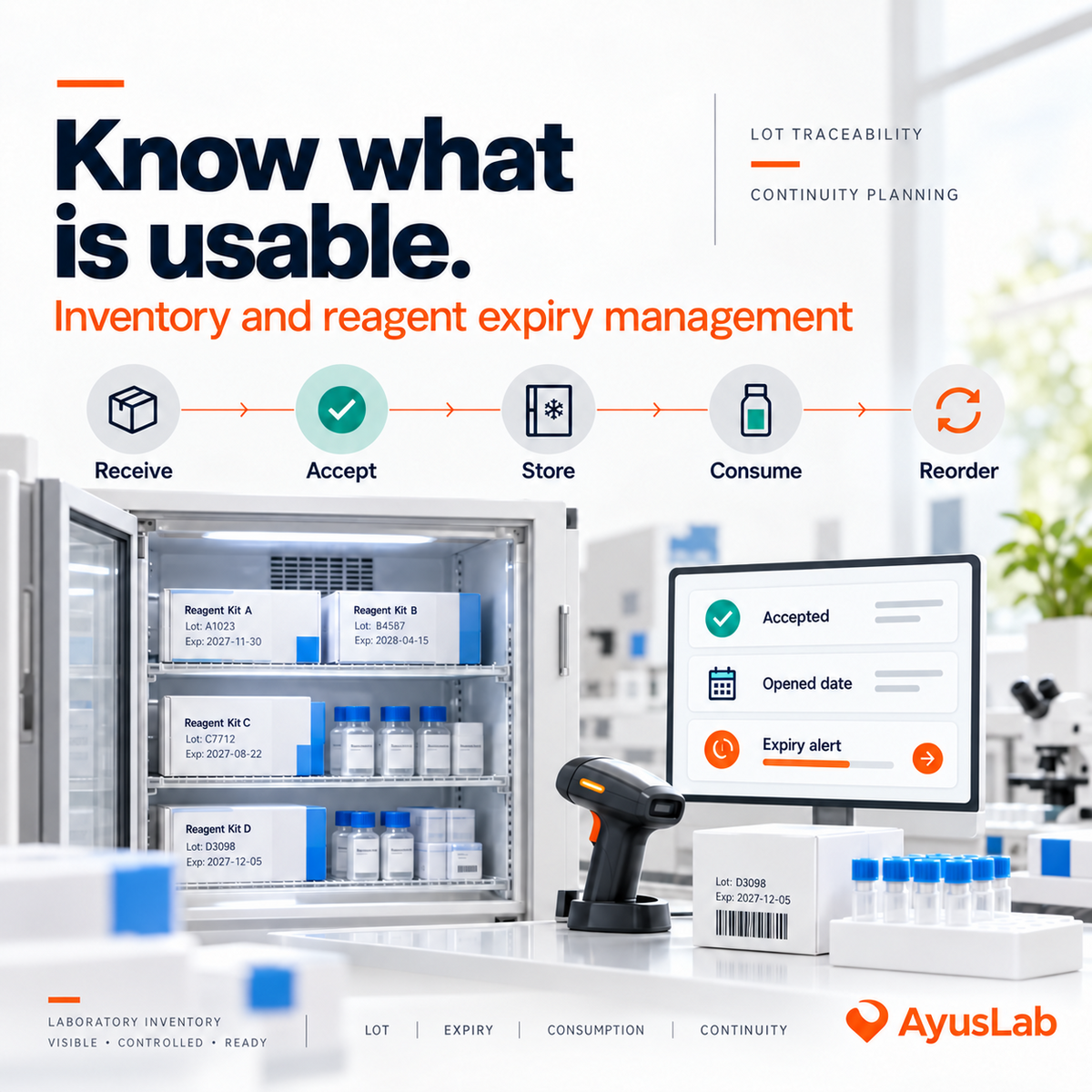
A laboratory can have shelves full of reagents and still be unable to test. The required lot may be expired, unopened stock may not have completed acceptance checks, an opened pack may have exceeded its usable stability, or the available quantity may be insufficient for calibrations, controls and patient samples.
Effective inventory management therefore asks more than "How many units are in stock?" It connects each item and lot with its supplier, receipt and acceptance status, storage conditions, usable life, consumption and the examinations it supports. That connection helps the laboratory act before expiry or stock-out interrupts routine work.
ISO 15189:2022 addresses reagents and consumables within the requirements for laboratory quality and competence. In India, NABL 112A provides additional guidance on storage, labelling and reagent records. The laboratory must interpret these requirements through its approved procedures, manufacturer instructions and applicable local regulation.
1. Understand the inventory risks
Inventory failure can affect availability and analytical control. Common risks include an essential reagent reaching zero stock, excess purchases expiring unused, the wrong lot being issued, storage excursions, unrecorded open dates, failed acceptance checks, delayed supplier delivery and stock shown by the system but missing physically.
The impact also depends on the item. A general consumable may have several approved alternatives, while an analyser-specific reagent can stop an entire test menu. Classify inventory by operational criticality, lead time, substitution options, storage needs and demand variability. This risk classification should influence buffer levels, review frequency and escalation - not create a single rule for every item.
Three quantities should remain distinct:
- On-hand stock: the physical quantity present.
- Available stock: accepted, within its usable period and not reserved or quarantined.
- Projected stock: available stock adjusted for expected consumption and confirmed replenishment.
2. Build complete item, lot and supplier records
An item master should use a stable code and clear description. Link it to the relevant analyser, method or test group; pack size and unit of issue; approved supplier and manufacturer; storage conditions; expected lead time; and any controlled substitute.
Lot-level records should include the manufacturer's lot or batch number, supplied expiry date, received quantity, supplier, purchase and receipt references, receiving location and current status. Where a kit contains components with different identities or stability, record them at the level needed by the manufacturer's instructions and the laboratory's procedure.
Traceability should work in both directions. Staff should be able to identify which lot was used for a run or period, and an investigation should be able to find results potentially associated with a recalled or unsuitable lot. The necessary granularity depends on the testing process and validated system design.
3. Separate receipt from acceptance
Delivery does not automatically make a reagent available for patient testing. On receipt, check the purchase reference, item, lot, quantity, expiry, packaging condition and required transport evidence. Record discrepancies, damage or temperature concerns and place affected stock in a controlled status.
The workflow should distinguish received, quarantined, accepted, rejected and returned stock. Only authorised personnel should release material for use after the required inspection or verification has been completed.
Acceptance is method-specific. It may involve visual inspection, quality-control material, comparison with an existing lot or other evidence defined by the manufacturer and the laboratory. NABL guidance includes discipline-specific examples of new-lot checks; these should not be turned into one universal verification protocol. The approved procedure must specify what is required for each reagent category.
4. Control storage, preparation and opened dates
Storage records must connect the item to its required environment and actual location. Refrigerators, freezers, controlled rooms and other stores need appropriate monitoring, excursion handling and contingency arrangements. Material should remain identifiable when moved between a central store, department, analyser and branch.
Expiry management involves more than the date printed on the unopened pack. Depending on the product, usable life may change after opening, reconstitution, preparation, thawing or loading onto an analyser. Record the event that starts the shorter period and calculate or assign the revised discard date according to the manufacturer's instructions and the laboratory's approved process.
NABL 112A states that labels should include applicable information such as receipt or preparation date, opening date, storage requirements and expiry. In-house reagents also need preparer identity, preparation date, storage requirements and expiry. A system alert is useful only if the underlying dates are captured correctly.
Arrange usable stock using first-expiry, first-out rather than merely first-in, first-out. Keep expired, rejected and quarantined material physically or electronically segregated from accepted stock so it cannot be issued accidentally.
5. Connect consumption with reorder decisions
Purchasing based only on last month's order can hide changes in workload, pack yield, wastage or supplier lead time. Consumption should reflect actual use, including patient testing, calibration, quality control, repeats, reruns, verification, maintenance and avoidable wastage where these can be measured reliably.
A reorder method can consider average demand, expected variation, supplier lead time, current usable stock, confirmed incoming stock and an approved safety buffer. Laboratories should set these values by item or risk group rather than publish a universal minimum.
System balances also need reconciliation with physical counts. Define cycle-count frequency, discrepancy tolerance, investigation responsibility and adjustment approval. Repeated differences may reveal unrecorded issues, unit-conversion errors, pack-size confusion or stock movement between locations.
6. Make expiry alerts actionable
One alert at the printed expiry date is too late. Use staged notifications that allow time to consume, transfer, return or replace stock appropriately. The alert should show the item, lot, location, quantity, relevant usable date and owner - not simply a red count.
Prioritise alerts using both time and likely consumption. A lot expiring in 30 days may be safe at normal demand, while another expiring in 90 days may already exceed projected use. Near-expiry review should lead to a recorded decision, such as continued planned use, approved transfer, supplier return, controlled disposal or replenishment.
Opened or prepared reagents require their own alerts because their usable period may end before the manufacturer's unopened expiry. Staff should never extend a date merely to avoid wastage unless the manufacturer and an approved, validated laboratory process support that decision.
7. Plan for stock-out without bypassing control
Continuity planning should identify critical reagents and define what happens when supply is threatened. Options may include prioritised procurement, approved stock transfer, an already validated alternative lot or method, a qualified referral laboratory, or temporary test-menu restrictions with appropriate communication.
The plan should identify who declares the disruption, who assesses available options, who approves a change and how requestors are informed. It should also cover analyser downtime when a reagent is available but cannot be used at the planned site.
Expired, unaccepted or improperly stored material is not a routine continuity solution. Any exceptional action must follow the laboratory's approved risk and authorisation process, applicable regulation and manufacturer instructions. Record the event, affected work, decision and recovery evidence.
8. Audit the complete inventory cycle
Audit a real lot from purchase request through receipt, acceptance, storage, opening, consumption and final disposal. Then test reverse traceability from the lot to the relevant examination activity. This reveals gaps that a shelf count will miss.
Useful indicators can include stock-out events for critical items, testing downtime attributable to supply, expired-stock wastage, near-expiry value, inventory discrepancies, urgent purchases and supplier lead-time performance. Define the numerator, denominator, exclusions, owner and action point before comparing periods or locations.
Management review should consider patterns, not only totals. Recurring expiry may reflect pack sizes that do not match demand. Frequent emergency orders may indicate weak forecasts, delayed approvals or unreliable suppliers. Review actions should have owners, due dates and effectiveness checks.
Where a LIMS can support visibility
Subject to product-owner verification of current behaviour, AyusLab may support item and supplier masters, lot and expiry records, purchase and receipt workflows, storage locations, consumption entries, reorder or expiry alerts, stock transfers and audit history. Where analyser, test or run relationships are available, they may improve lot traceability and help users understand which services depend on a threatened item.
The product should present the approved workflow and evidence clearly. It cannot determine reagent suitability, replace manufacturer instructions, validate a new lot or authorise a clinical or quality decision. Those responsibilities remain with competent laboratory personnel.
The operating principle is: know what is usable, what it supports, how quickly it is consumed and what controlled option exists if supply fails.
Frequently asked questions
What is the simplest definition of inventory and reagent expiry management for uninterrupted testing?
It is the controlled process of forecasting, receiving, accepting, storing, issuing and replenishing laboratory materials while preserving lot traceability and preventing expired or unsuitable stock from entering use.
Which part of the laboratory workflow is responsible?
Responsibility is shared among procurement, stores, section staff, quality management and authorised laboratory leadership. Each step needs a named owner, while the laboratory retains oversight of the complete process.
What records should remain available for review?
Maintain item and supplier masters, purchase and receipt records, lot numbers, expiry and opened dates, acceptance evidence, storage monitoring, movements, consumption, adjustments, alerts, stock counts, disposal, stock-out actions and audit history according to the approved retention policy.
Where can a LIMS help and where is professional judgement still required?
A LIMS can connect item, lot, location, consumption and alert records. Laboratory professionals must define inventory rules, assess receipt and storage concerns, approve lots, investigate discrepancies and decide how testing should continue during a shortage.
Reviewing your own lab's processes?
A Lab Growth Session walks through your turnaround time, rejection rates and workflow with our team.
Book a Lab Growth Session