Making laboratory reports easier for patients to understand safely
Learn how to make laboratory reports easier for patients to understand through clear structure, accurate result presentation, accessible design and approved education without adding diagnosis or treatment advice.
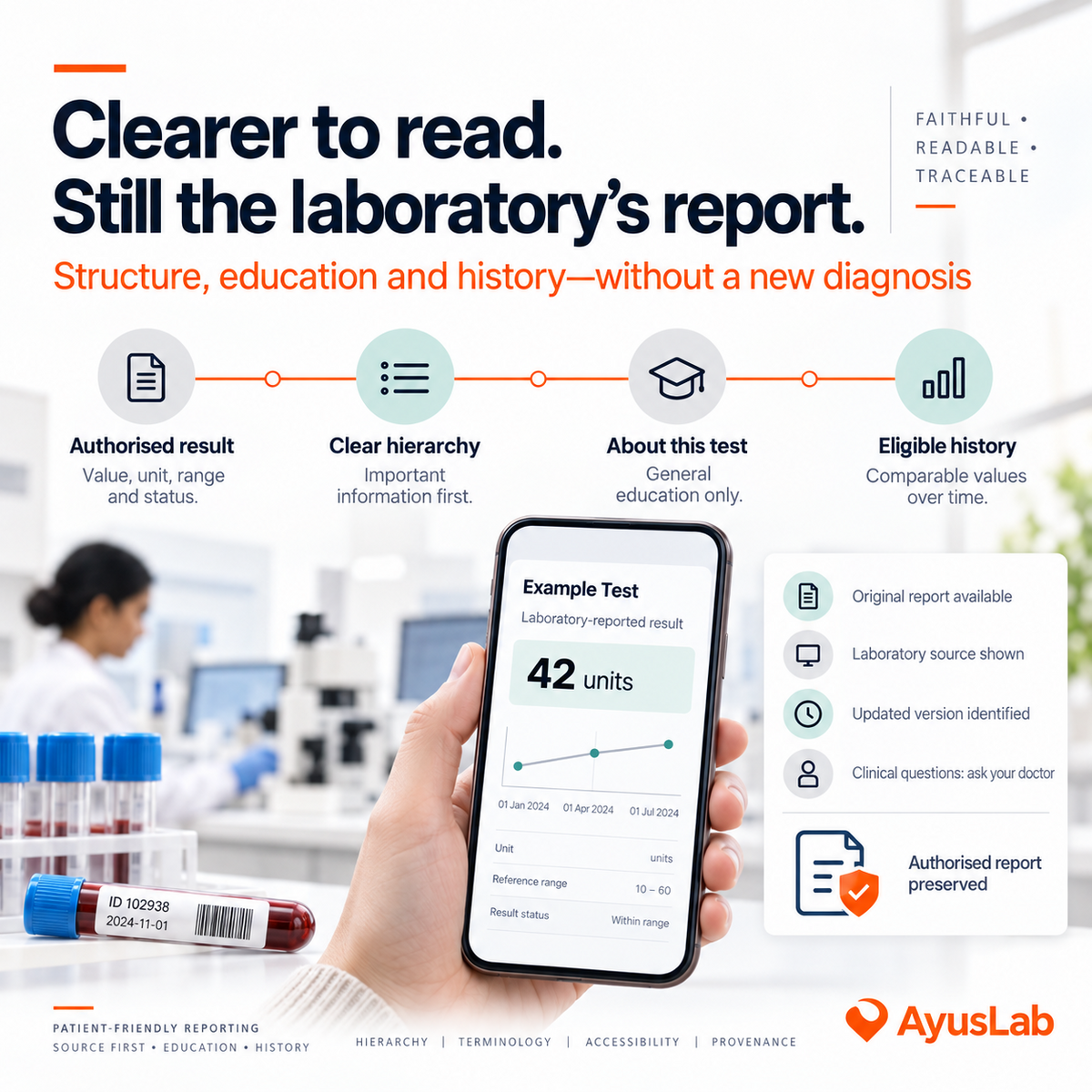
For many patients and referring doctors, the laboratory report is the most visible part of the laboratory’s work. They may never see the analyser, the quality-control records or the review process. They see the report.
That makes report design more than a cosmetic issue. A confusing report generates calls, creates uncertainty and can weaken confidence in the laboratory. A clear report helps the reader locate the result, understand what the laboratory has reported and know when further communication is required.
But clarity begins before the PDF or mobile screen is designed. It depends on how the laboratory configures tests, records methods, handles reruns, assigns abnormal and critical flags, authorises results and manages corrections.
The goal is therefore not merely to simplify the document. It is to make the laboratory’s controlled reporting process visible without changing its clinical meaning.
1. Treat the report as a laboratory service
A report should answer the reader’s immediate questions without making them decode the laboratory’s internal workflow:
- Which laboratory issued and authorised the report?
- Which patient, specimen and collection event does it belong to?
- Which tests were performed?
- What result, unit and reference interval did the laboratory report?
- Is the result marked normal, abnormal or critical under the laboratory’s approved rules?
- Are there relevant comments, limitations or follow-up communications?
- Has the report been corrected or replaced?
For the laboratory owner, the operational question is simple: can a patient or doctor find the correct information without calling the laboratory to reconstruct it?
Clinical questions still require an appropriate professional. Calls caused by missing units, unclear flags, unidentified corrections or poor mobile display are preventable process problems.
2. Start with controlled test and parameter masters
A clear report cannot be produced from inconsistent master data. Each reportable parameter should have an approved name, specimen context, unit, reference interval, decimal precision, method where relevant, result type and flagging rule.
The laboratory should define which information appears on the report and which remains in the analytical record. A patient does not need every internal code, but the system must retain the link between the reported result and its test, specimen, analyser event, method and authorised user.
Local abbreviations may be unclear to patients and external doctors. Display a readable name while keeping the original test identity traceable, and preserve the appropriate numeric, categorical or narrative format.
Reference intervals must come from the laboratory’s approved configuration. They may vary by method, population or other validated factors. A patient-facing application must not substitute a universal interval or independently invent “high,” “low” or “borderline” when the laboratory has not supplied or approved that status.
3. Show the method when it matters
Method information can affect how a result is understood or compared. It may therefore need to appear on the report for particular tests, accreditation requirements, referrals or laboratory policies.
The laboratory should define when the method, platform or technique is relevant and how it will be displayed consistently, including when a method change affects comparison with previous results.
Internally, retain traceability to the analyser, reagent or kit lot, calibration status, operator, run and applicable QC evidence. The patient report can remain concise while this evidence stays available.
If the method changes, the laboratory should decide whether earlier results remain comparable. A history graph should not silently connect values produced under materially incompatible conditions.
4. Record reruns, repeats and the selected reportable result
A result may be analysed again because of an instrument flag, dilution, analytical-range issue, unexpected value, QC concern or review rule. The final report should not show confusing unlabelled values, but the laboratory must retain the sequence.
The analytical record should retain:
- the initial result and analyser flags;
- the reason for rerun, repeat or dilution;
- each subsequent result and timestamp;
- any calculation or dilution factor;
- the operator or system action;
- the result selected for reporting; and
- the reviewer and authorisation decision.
Rerun and repeat should not be treated as interchangeable. They may involve different preparation, aliquot or recollection steps; the laboratory’s SOP should define each term and action.
The report normally presents the authorised reportable result, not every analytical attempt. Where the laboratory considers a comment necessary, it should be controlled and understandable. The LIMS should preserve the complete sequence so that a reviewer can explain how the reported value was reached.
5. Distinguish abnormal results from critical results
An abnormal result and a critical result are not the same thing.
An abnormal flag indicates that a result meets the laboratory’s applicable classification rule. It draws attention but does not establish a diagnosis or severity.
A critical result meets the laboratory’s approved critical-result criteria and activates a separate urgent communication process. The laboratory should define the applicable tests and limits, authorised recipients, read-back or acknowledgement requirements, escalation steps and documentation. These are laboratory-controlled and jurisdiction-specific; the blog should not publish universal clinical thresholds.
The report may display the laboratory-supplied flag clearly, using text as well as colour. However, a red label on a PDF is not evidence that a critical result was communicated. The communication record must show whom the laboratory contacted, when, how acknowledgement was obtained and what happened when contact failed.
Patient applications should reproduce the laboratory’s status rather than calculate a new one. Missing, conflicting or unexpected flags should be routed for verification—not silently converted into normal results.
6. Authorise the complete report, not only the number
Authorisation should confirm more than the numeric value. The reviewer may need to consider patient and specimen identity, analytical flags, rerun history, units, reference intervals, comments, previous results and relevant quality information.
The report should identify its status and required authorisation details. Draft, partial, final, corrected and cancelled reports must remain distinguishable, including what is complete or pending.
The system should prevent an unreviewed rerun or overwritten result from bypassing the approved authorisation process. Role permissions, timestamps and audit history should support the laboratory’s procedure rather than rely on staff memory.
7. Preserve corrections and communication history
When a report is corrected, simply replacing the PDF is insufficient. The laboratory should retain the original authorised report, the corrected version, reason for change, person who authorised it and relevant timestamps.
The corrected report should be clearly identified, and the laboratory should assess whether the change needs direct communication to the patient or referring professional. That decision and communication should also be recorded.
This protects the laboratory as well as the patient. If a question arises later, the laboratory can demonstrate what was first reported, what changed, why it changed and who was informed.
8. Make the authorised report easier to use
Once the laboratory process is reliable, presentation can reduce friction. Keep the result, unit, reference interval and flag together. Use readable test names, consistent grouping, sufficient contrast and text labels that do not depend on colour alone. Ensure tables remain usable on mobile screens and that the original authorised report can be opened.
Historical values may help patients and doctors review previous results, but only when parameter identity, specimen and units are compatible. Show dates and individual values without adding “improving,” “worsening,” treatment targets or predictions.
General education may explain what a test measures, but it must remain separate from patient-specific interpretation. The laboratory report remains the source; the treating professional interprets its clinical meaning.
What laboratory owners should monitor
Improvement should be visible in operations, not assumed from a redesigned template. Useful measures can include:
- report-format and clarification complaints;
- missing or incorrect units, intervals and flags;
- reports corrected after authorisation;
- reruns without a recorded reason;
- critical communications without complete acknowledgement evidence;
- failed or delayed report delivery;
- mobile report-display defects; and
- recurring queries from doctors or patients.
Review the underlying records, not only the totals. A rise in corrected reports may reflect a master-data problem, analyser-interface issue, weak review rule or training gap. The indicator should lead to action.
How AyusLab and AyusCare may support the laboratory
Subject to product-owner verification of current behaviour, AyusLab can support controlled test masters, values, units, reference intervals, source flags, analyser-linked results, rerun history, authorisation, corrected-report traceability and critical-result communication records. These are the laboratory-side controls that make a trustworthy report possible.
AyusCare can then present the laboratory-authorised report in a more readable patient view, provide approved general education for verified parameters and show compatible historical results. It should preserve the laboratory’s identity and original report, not create a second diagnosis or replace the laboratory’s judgement.
A better patient report therefore begins inside the laboratory. Reliable configuration, visible analytical history, correct abnormal and critical handling, controlled authorisation and traceable corrections come first. Clear presentation makes that work easier to use.
Frequently asked questions
What makes a laboratory report easier for patients to understand safely?
It combines accurate laboratory-controlled data with clear presentation: identifiable tests, results, units, reference intervals, source flags, report status and access to the authorised report—without adding diagnosis or treatment advice.
Should the analytical method appear on every laboratory report?
Not necessarily. The laboratory should define when the method or technique is relevant to interpretation, comparison, accreditation or its approved reporting policy. The complete method and analyser trace should remain available internally.
Should rerun results be shown to the patient?
The report generally shows the authorised reportable result. The complete rerun, repeat or dilution sequence should remain in the laboratory record with its reasons, actions and reviewer decision. Any patient-facing comment should follow the laboratory’s approved procedure.
What is the difference between an abnormal and a critical result?
An abnormal result carries a laboratory-approved status indicating that it is outside an applicable interval or rule. A critical result meets separate approved criteria and requires urgent, documented communication and escalation. One does not automatically mean the other.
Where can a LIMS help and where is professional judgement still required?
A LIMS can apply approved configurations, retain analytical history, display flags, control authorisation and preserve audit evidence. Laboratory professionals must validate the rules, assess analytical context, select the reportable result and manage critical or corrected-result communication.
Reviewing your own lab's processes?
A Lab Growth Session walks through your turnaround time, rejection rates and workflow with our team.
Book a Lab Growth Session