Corrected reports audit trails and traceability
Corrected reports preserve the history of changes made to a laboratory report after release. A proper audit trail records what changed, why, when, and who authorised and communicated the correction. Version control and traceability help ensure the updated report is clear, accurate, and safely communicated.
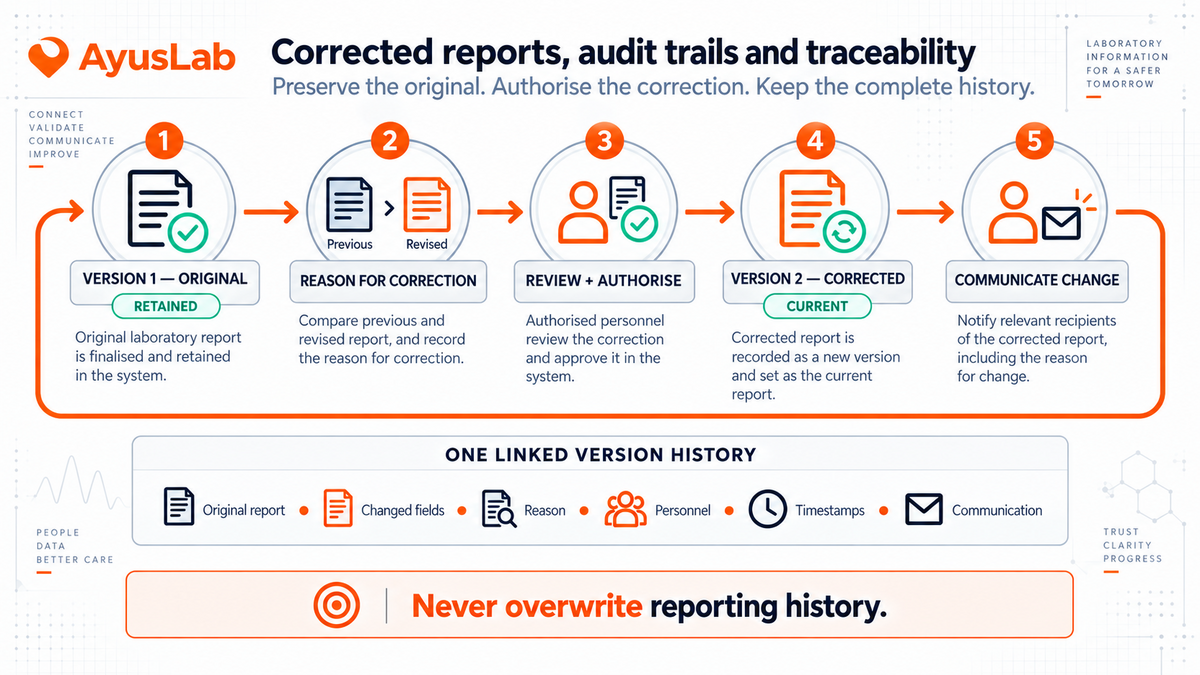
A released laboratory report may later need correction. Simply replacing the PDF or editing the result in place can hide what users originally received. A controlled correction preserves the original report, explains the change, identifies its authoriser and records how revised information reached the user.
That is the purpose of corrected reports audit trails and traceability: to make the complete reporting history understandable without presenting an obsolete version as current.
ISO identifies ISO 15189:2022 as the current published fourth edition for medical laboratory quality and competence. An accredited assessment worksheet aligned with the standard expects amended or revised results to be clearly identified, linked to the original report and communicated to the user. It also expects record amendments to remain traceable to previous versions or original observations.
1. Why reports are corrected
Reports may require correction because of transcription or unit errors, an incorrect reference interval, identification issues, instrument or interface problems, amended interpretation, later information, or a quality investigation.
The cause matters because it determines the response. A formatting correction may not carry the same patient risk as a changed result, specimen source or interpretive comment. The laboratory should therefore avoid treating every correction as an administrative edit. Its approved procedure should classify corrections, define responsibilities and link the required communication and impact assessment to risk.
Before changing a report, authorised personnel should establish what is wrong, the correct information and whether related results, patients, specimens or interfaces are affected. A wider process failure requires more than correcting one report.
2. Correction versus addendum
A correction or amendment changes information already issued because the original report is inaccurate, incomplete in a way that makes it misleading, or otherwise requires revision. An addendum generally adds new information after release without silently altering the original content - for example, an additional interpretive comment or a supplementary finding produced later.
Terminology varies between disciplines and jurisdictions, so the laboratory should define these terms in its own procedure. The distinction should be based on what happened to the authorised information, not merely which button a software screen provides.
Whichever label is used, the reader must be able to tell:
- that the document is revised or supplemented;
- which content is new or changed;
- when the change was made;
- why it was made, where appropriate;
- which earlier report it relates to; and
- which version is currently valid.
An addendum should not be used to conceal a correction. Likewise, a minor typographical change should not create clinical ambiguity by removing the earlier version from the record.
3. Authorisation rules
Correcting an authorised report should be a controlled action available only to personnel with defined competence and authority. The laboratory's procedure should specify who may initiate a correction, who may edit or enter the revised information, and who must review and authorise release. These roles may differ according to discipline, type of change and patient risk.
The reviewer should confirm the patient, request, specimen and examination; compare the change with source evidence; assess related information; and ensure clear presentation. Relevant evidence may include analyser data, worksheets, referral information, QC or previous results.
Urgent communication may precede the final corrected document, but it should remain authorised and documented. The procedure should connect preliminary communication, final correction and confirmation.
4. Version history
A corrected report should create a linked version history rather than overwrite history. The original authorised report remains available as the record of what was issued at that time, while the corrected report is clearly marked as the current version.
The NATA ISO 15189:2022 assessment worksheet states that a completely new report should be uniquely identified and traceable to the original report it replaces. It also indicates that revised results should be clearly identified and that the original report's patient identity and date should be indicated. If the reporting system cannot capture revisions, a separate record of the revision is still required.
Good version control answers four questions quickly:
- What did the original report say?
- What changed in the corrected report?
- Who authorised each version and when?
- Which users received or were notified of each version?
Each report and revision needs a stable identifier, status and relationship to the preceding version.
5. Communicating the change
Issuing a corrected report does not by itself prove that the relevant user noticed the change. Communication should be proportionate to the significance and urgency of the correction and follow the laboratory-approved procedure.
The record should identify the recipient, channel, timestamps, communicator, acknowledgement and any escalation. A clinically significant correction should clearly distinguish earlier from revised information.
Portal, email or interface transmission may support distribution, but the laboratory should define successful communication. Connected systems must receive the correct version and avoid displaying a superseded report as current.
6. Impact assessment
The laboratory should assess whether the original report could have influenced patient care. Authorised professionals make this assessment; software can present evidence but not the clinical decision.
Questions may include:
- Was the report viewed, printed, downloaded or transmitted?
- Did the correction change a result, unit, interpretation, patient identity or specimen description?
- Was the original information critical or time-sensitive?
- Who received it, and can receipt of the correction be confirmed?
- Could the same cause affect other results or reports?
- Is consultation, incident reporting or another corrective action required?
The NATA worksheet connects nonconforming work with evaluation of the clinical significance and impact on results already released. Where necessary, results are revised and the user is notified. The correction record should therefore link to the nonconformance, investigation and corrective action when they form part of the same event.
7. Audit trail fields
The audit trail should reconstruct the event without relying on staff memory. Depending on the laboratory procedure and jurisdiction, useful fields include:
- patient, request, specimen and examination identifiers;
- original report identifier, version, status and authorisation timestamp;
- original result, unit, reference information and comments;
- correction request, source, category and reason;
- fields changed, showing previous and revised values;
- initiator, editor, reviewer and authoriser identities;
- date and time of each action;
- corrected report identifier and link to the original;
- recipients, delivery routes, acknowledgements and escalations;
- impact assessment and related reports reviewed; and
- nonconformance, incident or corrective-action references.
The NATA interpretation of ISO 15189:2022 expects both original and amended data and files to be retained, including the alteration date, relevant time, changed aspects and personnel making the alteration. Access controls should prevent unauthorised changes, and the audit record itself should not be casually editable or removable.
After product-owner verification of current behaviour, AyusLab may be shown connecting report identifiers, versions, reasons, authorisers, timestamps and communication records. Such functionality can support traceability; it does not determine whether a correction is clinically adequate or make the laboratory compliant automatically.
8. Monitoring recurrent causes
Corrected reports are process evidence. A laboratory may monitor correction frequency using a defined denominator, time to corrected release, communication completion, repeat corrections and distribution by cause, discipline, analyser or interface.
Trends can reveal unstable master data, manual transcription, interface mapping defects, confusing report templates, training gaps or weak review rules. A rising correction rate needs investigation, but a very low rate is not automatically proof of quality; it may also reflect under-reporting or inconsistent classification.
Management review should consider patient risk, recurrence and the effectiveness of corrective actions. The goal is not merely fewer corrected reports. It is a reporting process in which necessary corrections are prompt, authorised, communicated and fully traceable and recurring causes are reduced.
The principle is straightforward: never erase reporting history. Preserve the original, identify the correction, authorise the new version, communicate it according to risk and keep the complete chain available for review.
Frequently asked questions
What is the simplest definition of corrected reports audit trails and traceability?
It is the ability to follow a report from its original authorised version through every correction, including what changed, why, when, by whom, under whose authorisation and how the revised report was communicated.
Which part of the laboratory workflow is responsible?
Corrected reporting is primarily a post-examination process, but it can involve pre-examination identification, analytical investigation, result authorisation, information-system control, nonconforming work and communication with laboratory users.
What records should remain available for review?
The original and corrected reports, previous and revised data, reasons, changed fields, personnel and timestamps, authorisation, communication history, impact assessment and linked investigation or corrective action should remain available according to the laboratory's retention procedure and jurisdiction.
Where can a LIMS help and where is professional judgement still required?
A LIMS can control permissions, preserve versions, record field-level changes, link reasons and approvals, identify the current report and retain delivery history. Professionals must determine the correction, assess clinical significance, authorise release, decide communication urgency and investigate recurrence.
Reviewing your own lab's processes?
A Lab Growth Session walks through your turnaround time, rejection rates and workflow with our team.
Book a Lab Growth Session