Making ISO 15189 part of everyday laboratory operations
ISO 15189 works best when its quality requirements are built into everyday laboratory processes, not treated as paperwork for audits. Routine controls such as sample identification, QC, result review, critical communication, and report correction create reliable evidence. Continuous monitoring, traceability, staff competence, and management review help maintain quality and improve laboratory operations.
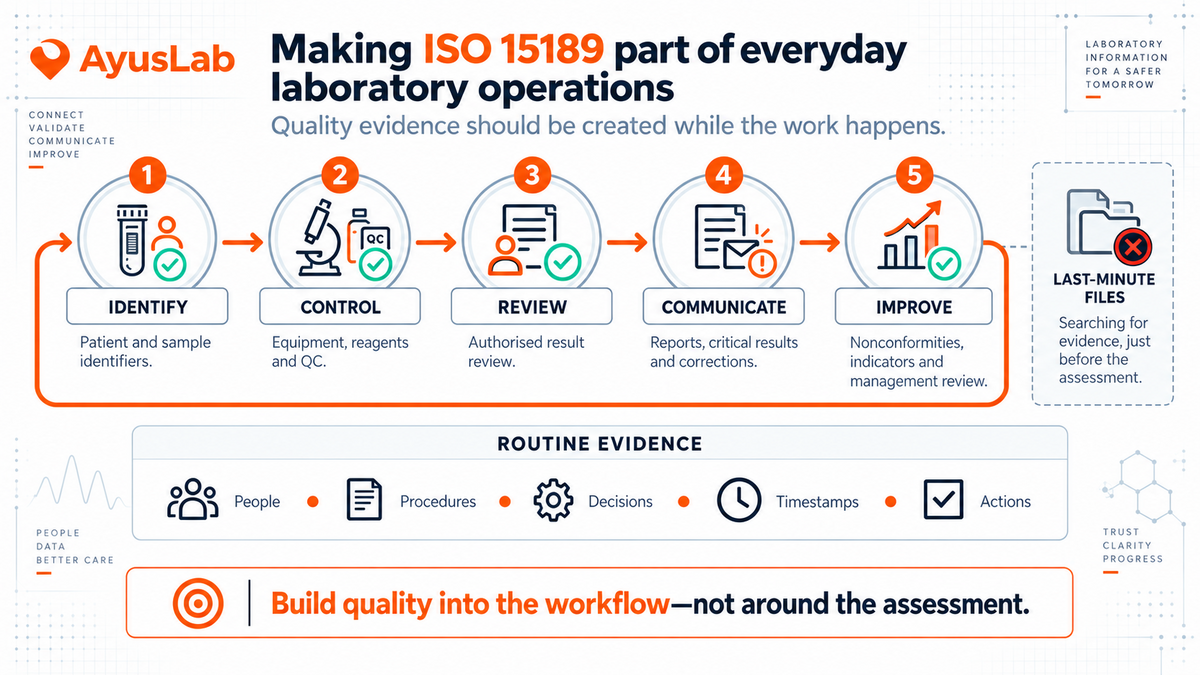
ISO 15189 is sometimes treated as a document-preparation exercise that becomes urgent before an accreditation assessment. That approach produces files, but it does not necessarily produce a dependable laboratory process.
The standard becomes useful when its principles shape ordinary work: identifying the correct patient, accepting the right sample, operating equipment properly, reviewing QC, authorising results, communicating critical findings, correcting reports transparently and learning from failures. Evidence then arises from the work itself instead of being reconstructed later.
ISO lists ISO 15189:2022 as the current published fourth edition for medical laboratory quality and competence. Laboratories should use a licensed copy of the standard together with current NABL or other jurisdictional requirements. Any clause number used in the final publication must be checked against that licensed text.
1. Quality system in routine operations
A quality system is not a separate activity owned only by the quality manager. It is the way the laboratory defines responsibilities, controls risk, performs examinations and demonstrates that its processes work as intended.
The practical question is not, "Do we have a procedure" It is, "Can competent staff follow the current procedure during routine work, and does the resulting record show what happened?" A process is embedded when the required action appears at the decision point. For example, sample acceptance is recorded at receipt, QC is reviewed when analytical performance is assessed, and report authorisation is attributed when the result is released.
Management should identify the high-risk points in the total testing pathway and decide what control and evidence each one needs. This converts policies into operating rules, responsibilities, records and review indicators.
2. Patient and sample identification
Quality begins before analysis. Requests, patient identifiers, labels, specimens, collection details and examinations must remain connected from registration to reporting. Staff should not rely on memory or informal corrections when information is missing or inconsistent.
At sample receipt, the workflow should support the laboratory's approved acceptance and rejection criteria. Authorised staff need to assess whether the sample is suitable for the requested examination and record the decision. When an exception is permitted for a clinically critical or irreplaceable sample, the exception, authorisation and relevant report limitation should remain traceable.
Routine evidence may include the identifiers used, collection and receipt times where relevant, sample type, condition, receiver, rejection or exception reason, recollection communication and links between aliquots and the original specimen. These records protect both the patient and the laboratory because they show how identity and suitability were controlled.
3. Equipment, reagents and QC
Reliable examination depends on more than a functioning analyser. The laboratory needs controlled equipment selection, installation, acceptance, maintenance and repair; reagent and consumable management; calibration where applicable; and internal quality control appropriate to the method and risk.
Manufacturer instructions and the laboratory's approved procedure belong inside this process. Maintenance should be scheduled and recorded, deviations assessed, and defective equipment kept out of use until acceptable performance is verified. Reagent lots, expiry, storage and preparation should be traceable to the examinations they affect.
IQC should be treated as a decision process rather than a chart stored for assessment. Controls are run at a laboratory-defined frequency, reviewed against approved criteria, and evaluated for shifts, trends or unacceptable performance. When QC is unacceptable, patient-result release is controlled while the laboratory investigates, corrects the problem and evaluates potentially affected results.
Calibration, IQC and EQAS answer different quality questions. Their records should connect to the relevant analyser, method, lot, date, staff member, review and action rather than remain isolated documents.
4. Review and reporting
An analyser result does not become an authorised patient report automatically. The laboratory should define who may review and release results and what information must be considered. Depending on the examination and approved rules, review may include QC status, specimen quality, reference or decision limits, previous results, delta checks, flags, comments and available clinical information.
Automated selection or release can support high-volume work, but its criteria need approval, validation, change control and ongoing review. Results routed for manual review should remain identifiable, together with the reviewer and relevant timestamps.
The report itself should be clear and unambiguous, identify the patient, laboratory, examinations and sample, and contain the information needed for interpretation. Evidence of authorisation and release should remain retrievable even when it is not displayed directly on the report.
5. Critical and corrected results
Routine report dispatch is not the same as urgent critical-result communication. The laboratory should define approved critical decision limits or findings, authorised recipients, communication methods, accuracy verification, acknowledgement, documentation and escalation when contact fails. The record should show who communicated what, to whom and when, including difficulties encountered.
Corrected reports require another form of traceability. The original authorised report should not disappear when a correction is issued. The revised report should be clearly identified, linked to the version it replaces and accompanied by the reason, changed information, authoriser, timestamps and user-notification record.
These processes demonstrate why everyday evidence matters. A policy stating that staff communicate critical results or preserve report history is not enough if the actual call, acknowledgement, escalation or version relationship cannot be reconstructed.
6. People, competence and documents
Training attendance is not identical to competence. The laboratory should define competence requirements for each role, assess personnel using suitable methods and authorise specific activities such as result review, reporting or alteration of patient data. Records should show training, assessment, authorisation and ongoing monitoring.
Documents must also work at the bench. Staff need access to the current approved procedure in language and detail they understand. Obsolete versions should be controlled, changes approved and significant updates communicated. Quick-reference instructions can help, but they must agree with the controlled procedure.
Competence and document control meet during change. When a method, analyser, reagent, interface or procedure changes, the laboratory should assess the effect, update documents, train affected staff and verify that the revised process works before treating it as routine.
7. Nonconformity and improvement
Errors, deviations and near misses should enter a controlled nonconformity process. Immediate action may contain the problem; for example, stopping an activity, withholding reports or removing equipment from service. The laboratory then assesses patient risk, including results already released, decides what is acceptable and determines whether users must be notified.
Not every incident requires the same investigation. The depth should reflect significance and recurrence. Where corrective action is needed, the laboratory should address the cause, assign responsibility, set a timeframe and evaluate whether the action was effective.
Trend review turns isolated records into improvement. Sample rejections, QC failures, corrected reports, delayed critical notifications, complaints and interface failures can reveal weaknesses that individual case closure may miss. Indicators need consistent definitions and denominators so management can distinguish change from noise.
8. Digital evidence and management review
A LIMS can make quality evidence easier to create during work by connecting patients, samples, equipment, QC, results, approvals, communications and corrections. Role-based access, timestamps, flags, version histories and audit trails can support traceability. This depends on validated configuration, controlled master data, suitable access rules and reliable interfaces.
After product-owner verification of current behaviour, AyusLab may be shown supporting specific records or review points. The article should not claim that software guarantees quality or compliance. A system cannot decide whether a sample exception is justified, whether a result is clinically significant or whether corrective action is adequate; those decisions remain with authorised professionals.
Management review should bring routine evidence together at planned intervals: objectives, quality indicators, audits, nonconformities, corrective actions, feedback, result-validity assurance, EQA, supplier performance, risks, improvements and resources. Its output should record decisions, owners and timeframes, and completion should be followed through.
This is the practical meaning of making ISO 15189 part of everyday laboratory operations: build the required controls into the workflow, create evidence when work occurs, review that evidence and improve the process. Assessment readiness then becomes a consequence of a functioning quality system - not a last-minute project.
Frequently asked questions
What is the simplest definition of making ISO 15189 part of everyday laboratory operations?
It means turning quality and competence requirements into routine responsibilities, controls, decisions and records across the total testing process.
Which part of the laboratory workflow is responsible?
Every part contributes: request and collection, sample receipt, examination, QC, result review, reporting, communication, record control and management oversight. Responsibilities should be assigned to competent, authorised personnel.
What records should remain available for review?
Records should demonstrate what the laboratory's approved procedures and applicable requirements expect, including identification, sample decisions, equipment and reagent history, QC, authorisation, critical communication, report correction, competence, nonconformities and management action.
Where can a LIMS help and where is professional judgement still required?
A LIMS can guide workflow, restrict actions, capture evidence, link records and make exceptions visible. Professionals must approve procedures, evaluate risk and clinical context, authorise decisions and determine whether evidence is adequate.
Reviewing your own lab's processes?
A Lab Growth Session walks through your turnaround time, rejection rates and workflow with our team.
Book a Lab Growth Session