Critical result communication as a closed loop process
Critical result communication ensures urgent laboratory results reach the correct authorised person accurately and are acknowledged. A closed-loop process includes communication, read-back, documentation, and escalation when contact or acknowledgement fails. Clear procedures and monitoring help laboratories improve patient safety and ensure reliable critical-result reporting.
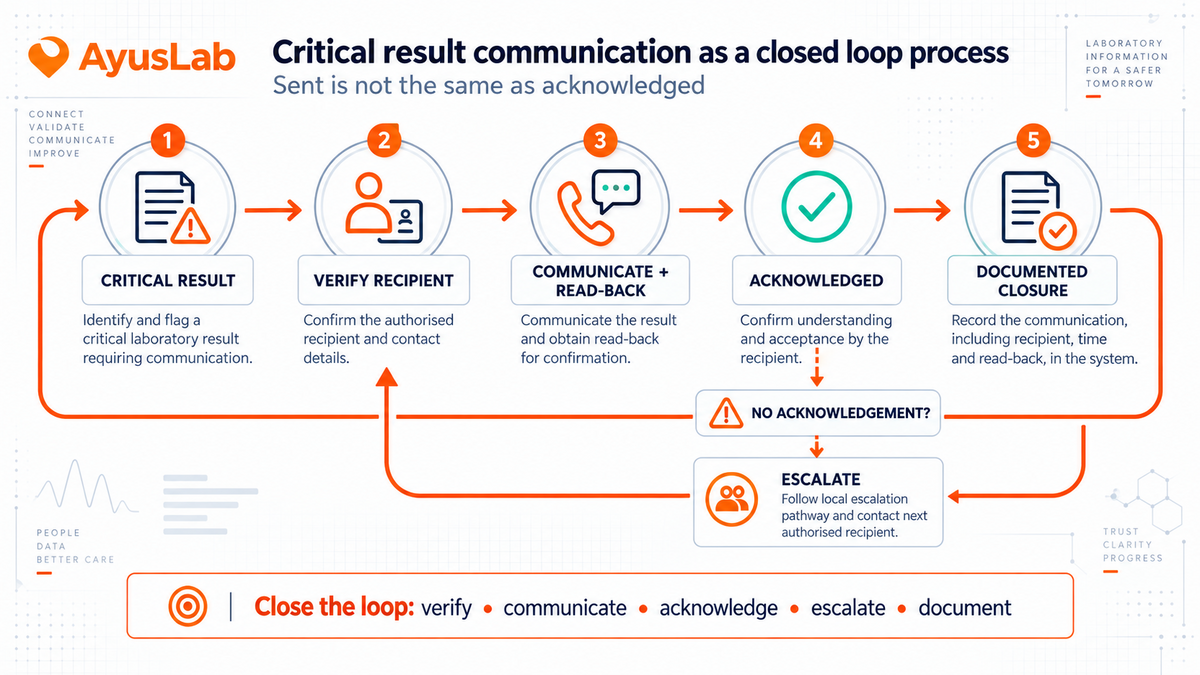
A critical result is not safely managed merely because a report has been released. The laboratory must also make sure that the result reaches an authorised person, is transmitted accurately, is acknowledged, and is escalated when the first contact attempt fails. That is what makes critical result communication a closed loop process.
Routine report dispatch and urgent communication answer different questions. Dispatch confirms issue through the normal reporting channel. Closed-loop communication confirms that the urgent message reached the right recipient and that the exchange was completed.
ISO lists ISO 15189:2022 as the current published fourth edition for medical laboratory quality and competence. An accredited assessment worksheet aligned with the standard identifies notification, documentation, verification of communication accuracy and escalation as core elements of critical-result reporting. Laboratories must still translate these principles into approved local procedures that reflect their patients, services, operating hours and jurisdiction.
1. Critical result versus abnormal result
An abnormal result falls outside a reference interval or another interpretive boundary. A critical result is one that meets the laboratory's approved criteria for urgent communication because delay may create significant risk to the patient. The terms should not be treated as interchangeable.
Some abnormal results require routine review but not immediate contact. Conversely, certain findings may require urgent communication because of the examination, patient group or clinical context. A published review in Clinical Chemistry also distinguishes critical results from significantly abnormal results and from critical tests, for which prompt communication may be required regardless of the numerical result.
The procedure should define its terminology, covered examinations and actions. Clear definitions help prevent missed notifications and alert fatigue.
2. Laboratory-approved limits
There is no single critical-result list suitable for every laboratory. Limits and reportable findings should be approved through the laboratory's governance process and aligned with the population served, clinical services, examination methods and applicable requirements. The procedure may need to account for age, specimen type, care setting, units, first occurrence, repeat results or other validated context.
ISO 15189:2022 links biological reference intervals and clinical decision limits to the patient population and patient risk. The NATA assessment worksheet further expects these limits to be defined, communicated to users, periodically reviewed and reconsidered when examination or pre-examination methods change.
The approved list should identify:
- the examination or finding;
- the relevant unit and specimen type;
- any population or location-specific condition;
- whether repeat verification is required and when it must not cause harmful delay;
- the intended recipient and communication route; and
- the escalation path when normal contact is unsuccessful.
Laboratories should not copy thresholds from an article without local clinical, technical and regulatory review.
3. Identifying the authorised recipient
The result must reach someone authorised and positioned to act within the organisation's agreed workflow. That may be the requesting clinician, another responsible medical practitioner, an authorised nurse, a designated service contact or another person defined by policy. The correct recipient can vary by inpatient, outpatient, emergency, referral and after-hours settings.
Before communicating, staff should verify the patient and request using approved identifiers and confirm the recipient's identity and role. Voicemail, an unverified number or a general inbox does not by itself demonstrate completed communication.
The request process should capture reliable contact information at the beginning of the testing pathway. Missing or outdated details discovered only after a critical result occurs turn a preventable data-quality problem into an urgent escalation problem.
4. Communication and read-back
The approved procedure should define permitted channels and privacy controls. Telephone communication remains common; secure messaging or integrated systems may be used when they authenticate the recipient, protect patient information, capture acknowledgement and trigger escalation.
During verbal communication, staff should use a consistent message containing the information required by local policy. This commonly includes the laboratory and caller, patient identifiers, examination, result, unit and relevant specimen or collection context. The recipient should repeat the essential information back, and the caller should compare it with the source record. Read-back is a control against misheard patient identity, decimal values, units or analyte names.
If the read-back is incorrect, the information should be stated again and reconfirmed. The objective is not merely to document that a call occurred; it is to verify that the urgent result was transmitted accurately.
5. Acknowledgement
Acknowledgement closes the communication exchange by showing that an authorised recipient received the message. It should be explicit rather than inferred from message delivery, report access or a ringing telephone.
For a call, acknowledgement can be captured through read-back and recipient confirmation. For electronic communication, the laboratory should define what counts as acknowledgement and the permitted response time. A "sent" status may prove transmission without proving human receipt.
Acknowledgement does not necessarily prove that clinical action occurred. Responsibility for treatment and follow-up belongs to the relevant clinical service under local policy. The laboratory should avoid claiming evidence it does not hold, while making hand-off responsibilities clear.
6. Escalation when contact fails
A closed loop needs a controlled route for an open notification. The procedure should define what staff do when the intended recipient does not answer, rejects the message, cannot be authenticated or fails to acknowledge within the locally approved period.
Escalation may move through alternative authorised recipients, the responsible unit, an on-call service, a senior clinician, laboratory leadership or another locally approved endpoint. The sequence, contact details, responsibility and timing should be usable during nights, weekends and service disruptions. Staff should not have to invent the pathway during an urgent event.
Every failed attempt and subsequent escalation should be recorded. If communication technology is unavailable, the downtime process should preserve the same controls as far as practicable: correct patient, correct result, authorised recipient, accuracy verification, acknowledgement and traceable documentation.
7. Records and audit evidence
The communication record should connect the result with the complete notification history. The NATA worksheet's interpretation of ISO 15189:2022 identifies evidence including the date and time, responsible person, person notified, results conveyed, verification of communication accuracy and difficulties encountered during notification.
A useful record can therefore include:
- patient, request, specimen and result identifiers;
- the critical-result rule or finding triggered;
- result review and release details;
- each contact attempt, channel and timestamp;
- the verified recipient's identity and role;
- information communicated and read-back status;
- acknowledgement time and outcome;
- escalation steps, exceptions and reasons; and
- corrections, amendments or incident references where applicable.
The final report remains part of the reporting process. Oral or urgent preliminary communication should not become an undocumented substitute for the authorised report.
Where current behaviour is confirmed by the product owner, an AyusLab workflow may help connect identifiers, flags, timestamps, recipients, acknowledgements, escalation events and review history. A LIMS can improve visibility and traceability, but configuration alone does not establish appropriate limits, select the right recipient or replace professional judgement.
8. Reviewing performance
Management review should examine whether the process works in practice, not only whether a procedure exists. Indicators should have clear definitions and denominators. Examples include the proportion of critical results acknowledged within the laboratory-approved time, median time from authorisation to acknowledgement, unsuccessful first-contact rate, escalations, read-back completion, missing contact details and documentation completeness.
Results can be segmented by service, shift, location, examination or route. Repeated delays may indicate outdated contacts, unclear ownership, excessive alerts, poor interoperability, inadequate staffing or a weak after-hours pathway.
Incidents, complaints and near misses should feed corrective action and risk review. Changes to limits, recipients, interfaces, message templates or automated rules should be approved, validated where applicable, communicated to users and monitored after implementation.
The practical principle is simple: a critical result is not closed when it is sent; it is closed when accurate communication to an authorised recipient is acknowledged and traceably recorded, with escalation completed when necessary.
Frequently asked questions
What is the simplest definition of critical result communication as a closed loop process?
It is a controlled process in which a critical result is identified, communicated accurately to an authorised recipient, acknowledged, documented and escalated if contact or acknowledgement fails.
Which part of the laboratory workflow is responsible?
It is primarily a post-examination process, but it depends on accurate request and contact data, validated examination and review processes, authorised result release, trained staff, clinical-user agreements and management oversight.
What records should remain available for review?
The laboratory should retain evidence required by its procedure and jurisdiction, including the result, timestamps, communicator, recipient, information conveyed, accuracy verification, acknowledgement, unsuccessful attempts, escalation and any subsequent correction or incident review.
Where can a LIMS help and where is professional judgement still required?
A LIMS may flag results, connect identifiers, create time-stamped tasks, record contact attempts and acknowledgements, escalate overdue events and support audits. Laboratory and clinical professionals must still approve limits, interpret context, determine recipients, manage exceptions and authorise actions. Product behaviour must be verified before publication.
Reviewing your own lab's processes?
A Lab Growth Session walks through your turnaround time, rejection rates and workflow with our team.
Book a Lab Growth Session