Delta checks in laboratory medicine
Delta checks compare a patient’s current and previous results to identify unexpected changes for review. They help detect possible specimen, analytical, identification, or reporting issues without assuming the result is wrong. Proper validation, documentation, and professional review are essential for using delta checks effectively.
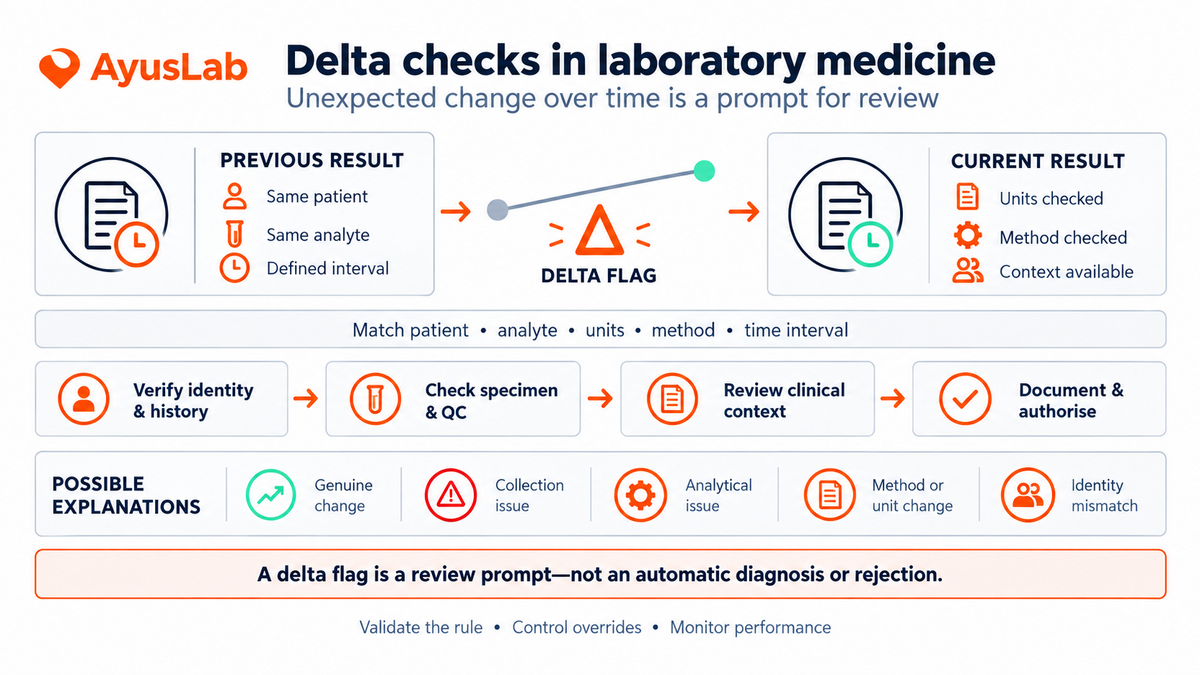
A delta check compares a patient's current result with an earlier result for the same analyte. When the change exceeds defined criteria within a specified interval, it is flagged under the laboratory's approved review workflow.
The flag does not prove either result is wrong. Genuine change, treatment, a different specimen, collection problem, analytical issue or identification error could produce the difference. The delta check makes it visible for authorised review.
The central principle is: use delta checks as validated review prompts - not as automatic clinical interpretations or universal rejection rules.
1. Definition and purpose
The "delta" is the difference between two results. A laboratory may evaluate absolute difference, percentage change, rate of change or another validated relationship. The comparison requires a reliable match to the patient, analyte, units and permitted interval.
Delta checks can support post-analytical review by identifying changes that deserve attention. Depending on the circumstances, they may help detect:
- possible patient or specimen misidentification;
- contamination or dilution during collection;
- unexpected analytical or reporting error;
- a difference caused by method, instrument, units or specimen type; or
- genuine change requiring review or communication.
A delta check does not replace internal QC, analyser flags, specimen-suitability checks, critical-result communication or clinical review. Each control answers a different question.
2. Selecting analytes
Not every analyte benefits equally. Selection should reflect patient population, testing frequency, biological behaviour, analytical performance and the errors sought.
Useful questions include:
- Is the analyte sufficiently stable within a person for change to be informative?
- How quickly can it change because of disease, treatment or physiological events?
- Are previous results commonly available within a relevant interval?
- Are results comparable across methods, sites and specimen types?
- Would a flag lead to a practical review action?
- How much review workload would the rule create?
An analyte with rapid legitimate variation may generate many false-positive flags. A broad limit may miss useful errors. Selection is a validation decision, not a borrowed list.
3. Absolute and percentage change
Two common calculations illustrate why one method does not suit every analyte.
Absolute delta = current result − previous result
The laboratory may use the magnitude or separate rules for increases and decreases. Absolute change uses the analyte's reporting units and may be easier to interpret near zero.
Percentage delta = (current result − previous result) ÷ previous result × 100
Percentage change expresses difference relative to the earlier value. It can work across a wide range but becomes unstable when the previous result is near zero, making a small change appear very large.
Some laboratories may evaluate change per unit of time or use different strategies for particular analytes. Whatever method is chosen, the direction of change, rounding, units, result range and handling of non-numeric or below-measuring-range results should be specified. This article does not provide universal thresholds.
4. Time intervals and patient context
A delta comparison needs a defined interval. Results separated by hours pose a different question from those separated by months. The interval should reflect the analyte, setting, rule purpose and meaningful prior data.
Context can explain a legitimate change. Relevant information may include:
- inpatient, emergency or outpatient status;
- recent transfusion, infusion, dialysis, surgery or treatment;
- timing of collection and specimen type;
- pregnancy, age or another applicable population factor;
- a change in method, analyser, laboratory site or reporting unit; and
- whether the previous result was preliminary, corrected or otherwise qualified.
These factors support authorised review, not automatic clinical interpretation. Define what information reviewers can use and when consultation is required.
5. Possible causes of unexpected change
An unexpected delta may arise from several parts of the total testing process.
Pre-analytical possibilities include wrong-patient collection, specimen mislabelling, contamination from an intravenous line, dilution, incorrect tube, unsuitable handling or a difference in specimen source.
Analytical possibilities include method interference, calibration or reagent problems, instrument malfunction, carryover or another issue that should be assessed alongside QC, analyser flags and related results.
Post-analytical or information possibilities include incorrect units, transcription or interface error, method-change effects, duplicate patient records, incorrect patient matching or a problem in the historical result.
The change may also be genuine. A delta flag should therefore never be described as proof of laboratory error or automatically used to suppress a valid result.
6. Review workflow
The approved procedure should state what happens when a result triggers a delta check. A practical review may include:
- Confirm the current and previous results belong to the same patient and analyte.
- Check dates, units, specimen types, methods, sites and report status.
- Review specimen condition, analyser messages, IQC and related results.
- Consider available clinical or treatment context without making an unsupported diagnosis.
- Repeat or verify testing only when the procedure and evidence justify it.
- Consult the requester or another authorised professional when necessary.
- Release, hold, correct or otherwise manage the result under the approved process.
Critical-result and urgent communication rules remain independent. A result should not wait for delta-check review if another controlled procedure requires immediate notification.
7. Overrides and documentation
An authorised reviewer may conclude that the change is explainable and release the result. That is not a failure of the delta check; the rule correctly brought the case to attention. The review decision should remain traceable.
Useful records include:
- current and comparison results, dates, units and methods;
- the rule and time interval that generated the flag;
- reviewer identity and review time;
- specimen, QC, analyser and contextual checks performed;
- repeat or verification results, where applicable;
- reason for override or disposition;
- communication and person contacted; and
- final authorisation or subsequent correction.
Standardised reason codes support monitoring, while free text can preserve necessary context. Avoid a single "override" button that records no reason or reviewer evidence.
8. Validation and ongoing monitoring
Before use, evaluate rules with representative local data. Assess patient matching, comparison-result selection, methods, units, relevant-event detection and review workload.
Monitor flag frequency, reasons, actions, detected errors, overrides, turnaround-time impact and missed events found elsewhere. A frequent but unhelpful rule may need refinement; a rule that never flags also deserves review.
Revalidate or verify the process after relevant changes to methods, instruments, interfaces, units, patient identifiers, historical-data migration or reporting logic. The review should include both the calculation and the downstream workflow.
ISO 15189:2022 is the current international standard for quality and competence in medical laboratories. NATA's public ISO 15189:2022 assessment worksheet reflects review of results against available clinical information and previous examination results, plus validation and periodic review of automated selection and reporting criteria. Published research on selecting delta-check methods illustrates why calculation approaches and limits differ by analyte. Indian laboratories should verify current applicable NABL documents and controlled local procedures before implementation.
How a LIMS can support delta checks
A LIMS can support reliable patient matching, retrieve eligible previous results, apply configured calculations and time intervals, display comparison details and route flagged results for review. With verified behaviour, it may also preserve reviewer actions, override reasons, communications and audit history.
Software cannot determine whether a change is clinically genuine, identify the cause or decide the correct disposition without professional review. Poor identity matching, unit mapping or method comparability can make an automated rule unsafe or misleading.
Frequently asked questions
What is the simplest definition of a delta check?
A delta check compares a current laboratory result with a previous result for the same patient and flags a laboratory-defined amount of change for review.
Which part of the laboratory workflow is responsible?
The comparison usually supports result review and release. Technical staff, authorised reviewers, quality personnel and laboratory leadership may share responsibility for rule design, validation, review and monitoring.
What records should remain available for review?
Keep the paired results, dates, methods, units, rule, interval, flag, reviewer, checks performed, disposition, override reason, repeat results and communications.
Where can a LIMS help, and where is professional judgement still required?
A LIMS can perform consistent comparisons, display context and preserve workflow history. Professionals must validate the rule, interpret the flag, investigate possible causes and authorise the result.
Reviewing your own lab's processes?
A Lab Growth Session walks through your turnaround time, rejection rates and workflow with our team.
Book a Lab Growth Session