QC, calibration and EQAS: how they work together
Calibration establishes the relationship used to produce analytical results, internal quality control (IQC) monitors ongoing stability, and external quality assessment (EQAS) provides independent comparison. Together, they provide complementary evidence of analytical performance and help laboratories identify, investigate, and address potential problems.
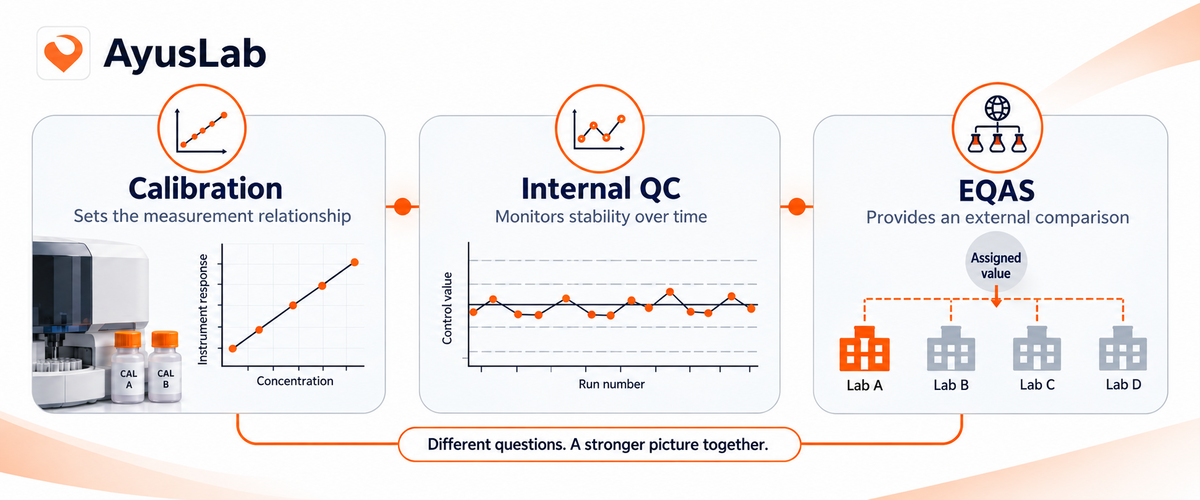
Calibration, internal quality control and external quality assessment are often discussed together, making them sound like three versions of the same check. They are not.
Each answers a different question. Calibration establishes how a response becomes a result. Internal quality control, or IQC, monitors stability during routine work. An external quality assessment scheme, or EQAS, independently compares the laboratory's performance.
A satisfactory result in one does not replace the other two. A calibrated system can later drift. Stable controls can remain centred around a biased target. A good EQAS result is only a periodic snapshot.
1. Three different quality questions
The simplest way to understand the relationship is to separate the questions:
| Process | Question it answers | Main limitation |
|---|---|---|
| Calibration | How should the system's response be related to a measurement result? | It does not continuously monitor later performance. |
| Internal QC | Is the examination system behaving consistently against its established control targets? | It may not reveal a bias shared by the calibration and control system. |
| EQAS | How does the laboratory's result compare with an external assigned value or an appropriate peer group? | It is periodic and usually retrospective, not a daily release control. |
Together, they show the analytical process's measurement basis, stability over time and external comparability.
ISO 15189:2022 specifies requirements for quality and competence in medical laboratories. Apply the controlled standard with accreditation requirements, manufacturer instructions and approved procedures. Indian laboratories should verify the latest applicable NABL documents rather than treating an article as a compliance rule.
2. What calibration establishes
An instrument observes a response—such as absorbance, an electrical signal or emitted light—and uses a defined relationship to calculate a result.
Calibration establishes or updates that relationship using assigned calibrator values. It may involve a factor, curve or several points. Where an appropriate reference system exists, the calibration hierarchy supports metrological traceability.
In formal metrology, calibration establishes a relationship between measurement-standard values and corresponding indications; it is not identical to adjustment. The International Vocabulary of Metrology explains this distinction. Analyser software may nevertheless call its curve-setting workflow “calibration.”
Calibration may be required when introducing a method, at defined intervals, with specified lot changes, after certain maintenance, or following an investigation. The trigger is method-specific.
Passing calibration means its acceptance criteria were met at that time. It does not establish continued stability; internal QC provides that view.
3. What internal QC monitors
Internal QC uses control material tested at defined intervals and trigger points. Results are compared with laboratory-approved targets and limits, often using charts and statistical rules to identify unexpected variation, shifts or trends.
Its operational question is: Is the analytical system still behaving as expected?
IQC can reveal post-calibration change, deterioration, reagent instability, imprecision or another problem. When QC is unacceptable, the laboratory investigates and decides whether testing or release must pause.
IQC is frequent and close to routine work, but not independent. If targets were established with a consistent bias, results might remain stable around that biased mean. IQC alone therefore cannot establish external comparability.
For a fuller explanation of control materials, charts, trends and corrective action, link here to the published article Internal quality control in medical laboratories explained.
4. What EQAS compares
In a typical EQAS round, an external provider sends material without disclosing the expected result. The laboratory handles it through its routine process, as far as permitted, and submits the result on time.
The provider evaluates the result against an assigned value, method or instrument group, or another defined comparison. The report may identify unacceptable performance or persistent difference.
EQAS may reveal calibration bias, method differences, incorrect units, transcription problems or other weaknesses. Interpretation must consider scheme design, target assignment, peer group, material commutability and scoring. A poor score does not automatically prove analyser failure.
EQAS providers themselves may operate under competence requirements such as ISO/IEC 17043:2023. The RCPAQAP explanation of IQC and EQA also illustrates their complementary roles.
5. A practical timeline
Consider a laboratory introducing a new reagent lot on an analyser:
- The laboratory completes the required lot checks and calibration or calibration verification according to the manufacturer's instructions and its procedure.
- Appropriate control materials are tested. Acceptable IQC supports proceeding with routine work.
- During operation, IQC continues at the defined frequency and after relevant trigger events. Results are reviewed for both immediate rejection and developing patterns.
- When an EQAS sample arrives, it is processed through the normal authorised workflow without special treatment intended to improve the score.
- When the EQAS report is returned, the laboratory reviews the result even if it is acceptable. An unacceptable result or recurring bias is investigated and connected back to calibration, IQC, reagents, method performance, staff practice and reporting.
This is not a universal schedule. It shows how the three processes connect in routine practice.
6. Common misconceptions
“If calibration passes, results are reliable until the next calibration.” Calibration applies at a defined time. Problems can develop later, so IQC continues.
“Calibration and QC are the same.” A calibrator helps establish the result-producing relationship. A control is used to monitor that established system. Treating control material as a calibrator can hide rather than detect error.
“If QC fails, recalibrate immediately.” Recalibration may be appropriate, but not automatic. First investigate the control, reagent, instrument, environment, recent events and result pattern.
“A good EQAS score proves everyday testing is correct.” EQAS assesses selected material at selected times. It cannot replace the more frequent view provided by IQC.
“An EQAS failure always means the instrument is wrong.” The cause may involve method bias, peer-group selection, material effects, unit conversion, transcription, sample handling or other parts of the workflow. Investigation must follow the evidence.
7. Records and responsibilities
Connect the three activities instead of storing unrelated certificates and printouts. Records may include:
- calibration date, reason, calibrator and reagent lots, assigned values, curve or factor, acceptance and authorisation;
- IQC material, lot, level, target, limits, results, charts, rule flags, review and corrective action; and
- EQAS provider, round, material, raw result, submitted result, method details, report, score, investigation and follow-up.
Trained staff perform and record authorised activities. Senior staff review exceptions and trends. The laboratory director or authorised professional approves procedures and patient-result decisions, while the quality function monitors completion and corrective-action effectiveness.
Management review should ask whether all three sources tell a consistent story. Post-calibration IQC shifts, stable IQC with recurring EQAS bias, or EQAS transcription errors indicate different weaknesses.
8. How a LIMS supports visibility
A LIMS can help connect calibration events, reagent and control lots, IQC results, charts, reviews, EQAS rounds and corrective actions. It may also provide reminders, configured alerts, permissions and an audit trail, depending on verified product behaviour and laboratory configuration.
The purpose is not to let software decide whether a method is acceptable. It is to make the evidence easier to see and trace so that authorised professionals can make and document the decision.
AyusLab publication note: Before adding claims or screenshots, verify which calibration, IQC and EQAS records AyusLab supports, how they connect, what notifications exist and what the audit trail retains. Do not claim guaranteed quality, safety or compliance.
Frequently asked questions
What is the simplest explanation of how QC, calibration and EQAS work together?
Calibration establishes how an analytical response becomes a result. Internal QC monitors whether that system remains stable. EQAS independently compares the laboratory's performance with an assigned value or suitable peer group.
Which part of the laboratory workflow is responsible?
These processes primarily support the analytical examination phase, although EQAS may also reveal problems in result calculation, units, transcription or reporting when those steps are included in the scheme.
What records should remain available for review?
Retain calibration inputs and acceptance, IQC results and reviews, EQAS submissions and reports, relevant lot and instrument details, investigations, corrective actions, patient-result assessments where required and authorisation records, subject to applicable retention requirements.
Where can a LIMS help, and where is professional judgement still required?
A LIMS can connect records, display trends, manage review status and improve traceability. Laboratory professionals must define the procedures, interpret exceptions, investigate causes, assess patient-result impact and authorise action.
Reviewing your own lab's processes?
A Lab Growth Session walks through your turnaround time, rejection rates and workflow with our team.
Book a Lab Growth Session